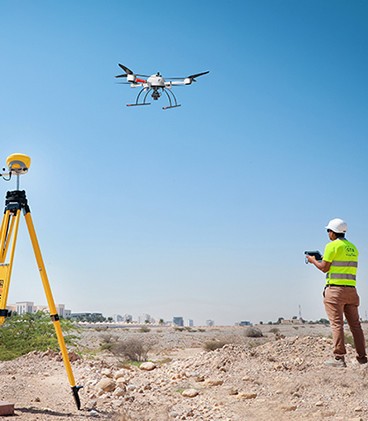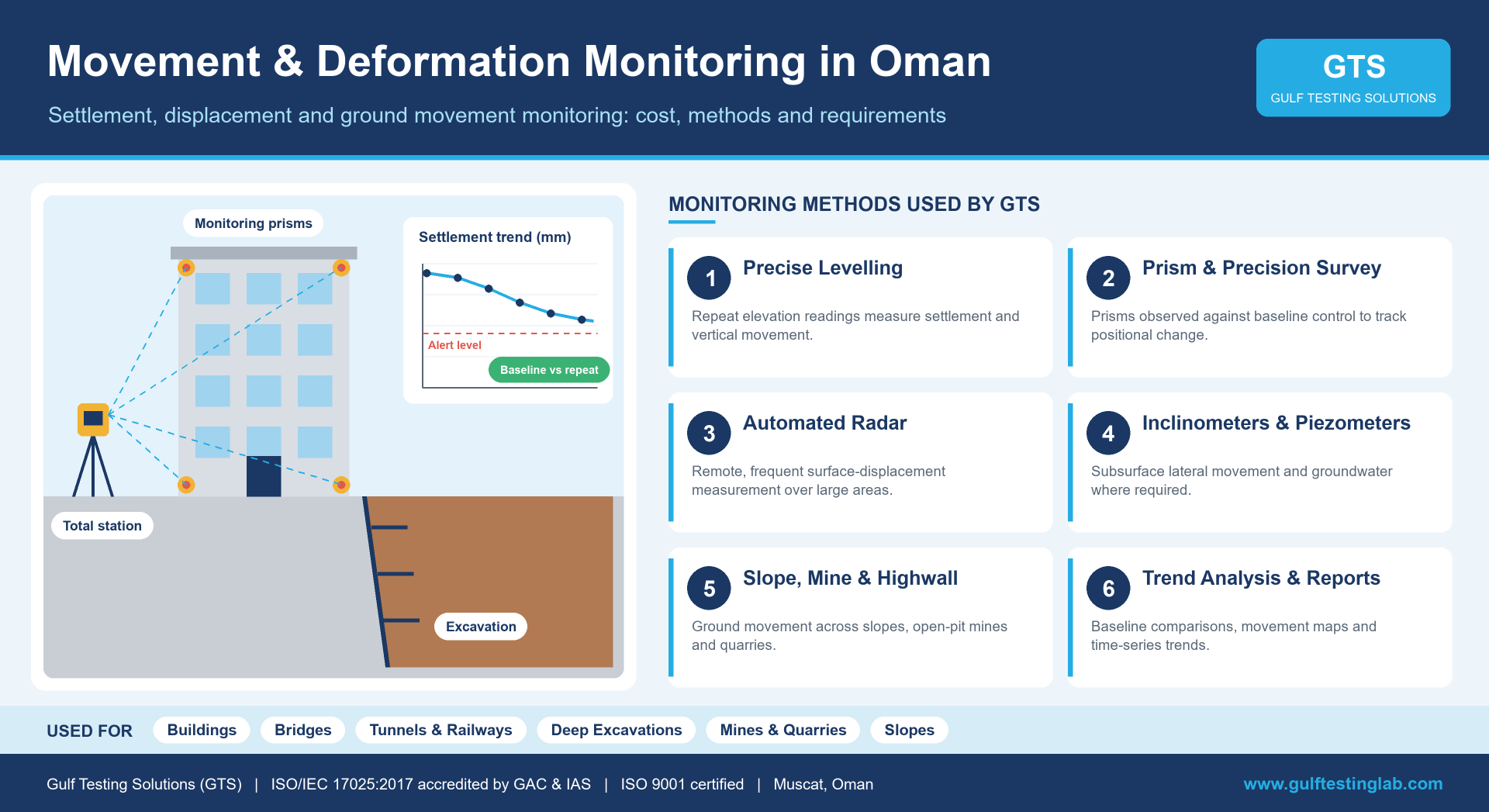
Movement and deformation monitoring in Oman measures and tracks settlement, displacement, deformation and ground movement across structures, construction areas, infrastructure, slopes, mines and underground environments.
At Gulf Testing Solutions (GTS), monitoring solutions combine precision surveying, prism monitoring, precise levelling, automated radar systems and project-specific instrumentation. Methods are selected according to site conditions, accuracy requirements and monitoring frequency.
This guide outlines the costs, methods, applications and requirements of structural and ground movement monitoring in Oman.
What Is Movement and Deformation Monitoring?
Movement and deformation monitoring is the systematic measurement of changes in the position, level or shape of structures and ground over time. Initial baseline measurements are compared with repeat observations to identify movement and trends.
Monitoring can measure:
- Vertical settlement and changes in elevation
- Horizontal displacement and positional changes
- Structural deformation and changes in geometry
- Ground, slope and highwall movement
- Subsurface lateral movement and groundwater conditions where required
- Movement patterns through time-series analysis
The resulting data helps engineers evaluate measured changes and determine whether further investigation or action is necessary.
Why Is Movement and Deformation Monitoring Important in Oman?
Construction, excavation, infrastructure development and mining can affect nearby buildings, retaining systems and ground conditions. Consistent monitoring provides evidence for engineering assessment and project management, supporting:
- Construction and excavation risk management
- Structural settlement and displacement assessment
- Monitoring of adjacent buildings, bridges, tunnels and railways
- Slope, highwall, mine and quarry movement monitoring
- Long-term infrastructure and industrial-asset observation
- Clear movement trends and periodic reporting
Movement and Deformation Monitoring Cost in Oman
There is no standard monitoring price for every project. A programme for periodic building settlement readings differs from a large-scale slope-monitoring programme using automated radar.
Costs are influenced by:
- Number and location of monitoring points
- Size and nature of the structures or ground area
- Accuracy and monitoring frequency
- Project duration and access requirements
- Precision surveying, levelling, prisms or radar deployment
- Piezometer and inclinometer instrumentation where required
- Mobilisation, data analysis and reporting
A site-specific quotation based on the monitoring plan is the most reliable way to estimate costs.
Factors Affecting Movement and Deformation Monitoring Cost in Oman
1. Number of Monitoring Points
Each installed or designated point requires initial measurement and repeated observation. Greater point density increases installation, survey time, processing and reporting.
2. Monitoring Frequency
Observations may be scheduled daily, weekly, monthly or at key construction stages. Where suitable, automated radar supports frequent remote surface-displacement measurement.
3. Duration of Monitoring
Projects can require monitoring for weeks, months or longer. Extended programmes increase the number of measurement and reporting cycles.
4. Required Accuracy
Sensitive assets may need precise levelling, high-precision positional observations and stable reference control. Greater accuracy requirements can increase field and quality-control effort.
5. Manual vs Automated Monitoring
Scheduled precision surveying and prism measurements can suit structural monitoring. Automated radar is relevant to large ground, slope and highwall areas where frequent remote measurement is required.
Methods Used for Movement and Deformation Monitoring in Oman
GTS provides two service areas: Structural Movement Monitoring and Ground Movement Monitoring. The methods below are used across these services.
1. Precise Levelling
Repeated elevation observations measure settlement and vertical movement of structural points, foundations and other selected locations.
2. Precision Survey Monitoring
Precision instruments are used to measure structural displacement and positional or geometric changes against baseline survey control.
3. Prism Monitoring
Survey prisms or defined monitoring points are observed repeatedly to establish changes in position over time.
4. Structural and Deformation Monitoring
Baseline and repeat measurements support the assessment of buildings, bridges, tunnels, railways and industrial facilities.
5. Inclinometer Monitoring
Inclinometers can be included where monitoring of subsurface lateral movement is required around slopes, excavations or retaining systems.
6. Piezometer Monitoring
Piezometers can be specified to track groundwater conditions relevant to a ground movement monitoring programme.
7. Ground, Slope and Highwall Monitoring
Precision survey methods and project-specific instrumentation measure movement across slopes, excavations, highwalls and retaining systems.
8. Mine and Quarry Monitoring
Surface displacement is monitored across open-pit mines, quarries and highwalls, with movement trends reviewed over time.
9. Automated Radar Monitoring
Automated radar enables remote and frequent surface-displacement measurement across extensive ground monitoring areas.
Building Settlement Monitoring in Oman
Settlement monitoring is a core structural movement service. Precise levelling measures elevation changes at selected locations and compares them with baseline readings.
- Baseline Survey
- Point Installation
- Repeat Measurements
- Data Comparison
- Trend Analysis
- Reporting
- Baseline Survey: Initial levels and positions are recorded.
- Monitoring Point Installation: Selected points and reference control are established.
- Repeat Measurements: Observations follow the agreed monitoring schedule.
- Data Comparison: Measurements are compared with baseline and earlier results.
- Trend Analysis: Changes and movement patterns are assessed.
- Reporting: Structured results, comparisons and trends are issued.
Building Monitoring During Excavation
Deep excavations may affect nearby buildings, ground, retaining systems and infrastructure. A combined monitoring programme can use precise levelling, prism and position monitoring, and project-specific ground instrumentation, including:
- Settlement and level monitoring
- Structural displacement and deformation monitoring
- Monitoring of adjacent structures and retaining systems
- Inclinometer and piezometer measurements where required
- Baseline comparison and periodic reporting
Monitoring Adjacent Buildings During Construction
Repeat monitoring of neighbouring buildings provides a measurable record before and during construction. Monitoring locations and frequency should reflect site conditions and engineering requirements. A typical scope includes:
- Baseline structural observations
- Selected prism and level monitoring points
- Repeat displacement and settlement measurements
- Periodic comparisons and movement trend analysis
- Structured monitoring reports
Requirements for a Movement and Deformation Monitoring Survey in Oman
- Project Scope: Identify the structures, excavation areas, slopes, mines or other assets involved.
- Monitoring Objectives: Define settlement, displacement, deformation or ground movement parameters.
- Baseline Data: Establish initial measurements before potentially influential work.
- Stable Reference Points: Select suitable survey control for reliable comparisons.
- Required Accuracy: Confirm measurement tolerances and quality requirements.
- Monitoring Frequency: Agree on observation frequency, duration and project phases.
- Instrumentation: Specify precision surveying, prisms, levels, radar, inclinometers or piezometers as appropriate.
- Reporting Format: Agree on trends, movement maps, tables and report intervals.
Movement and Deformation Monitoring Deliverables
Depending on the agreed scope, GTS monitoring deliverables may include:
- Baseline monitoring records and location plans
- Settlement and level measurement tables
- Displacement and deformation observations
- Prism and position monitoring records
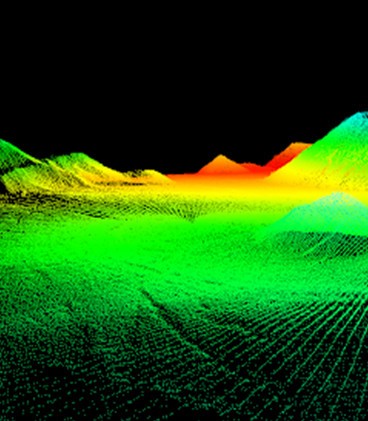
- Movement maps and spatial visualisations
- Time-series movement trends and comparison charts
- Groundwater and subsurface movement records where instrumented
- Periodic structured monitoring reports
Reporting is intended to make the measured changes understandable to project engineers, contractors and other stakeholders.
Applications of Movement and Deformation Monitoring in Oman
Structural Movement Monitoring
Best suited for:
- Buildings and adjacent structures
- Bridges and infrastructure
- Tunnels and railways
- Deep excavations and retaining structures
- Industrial facilities
Ground Movement Monitoring
Best suited for:
- Open-pit mines and quarries
- Natural slopes and highwalls
- Excavations and construction areas
- Retaining systems and areas affected by ground movement
How to Get a Movement and Deformation Monitoring Quote in Oman
Provide clear project information so that the appropriate monitoring method and reporting frequency can be selected:
- Project location and site access details
- Type and number of structures or ground areas
- Project plans and monitoring boundaries
- Purpose and movement parameters to measure
- Approximate number of monitoring points
- Required accuracy and monitoring frequency
- Expected monitoring duration
- Any radar, piezometer or inclinometer requirements
- Required reports, movement maps and trends
- Construction, excavation or mining schedule
Choose a Professional Movement and Deformation Monitoring Company in Oman
Reliable monitoring depends on an appropriate method, stable reference measurements, repeatable observations and clear interpretation of trends. GTS provides structural and ground movement monitoring using precision surveying, prism observations, precise levelling, automated radar and project-specific instrumentation.
Monitoring approaches are selected based on the site, accuracy requirement and observation frequency rather than applying one method to every project.
Get Movement and Deformation Monitoring Services in Oman
GTS provides Structural Movement Monitoring for buildings, bridges, tunnels, railways, excavations, adjacent structures and infrastructure, together with Ground Movement Monitoring for slopes, mines, quarries, highwalls and construction environments.
Services include settlement and level monitoring, structural deformation and prism monitoring, radar-based surface displacement observation, relevant subsurface instrumentation, movement mapping, trend analysis and structured reporting.
Need movement and deformation monitoring in Oman? Share your project location, site conditions, expected monitoring period and reporting requirements with GTS through www.gulftestinglab.com to request a tailored quotation.
Frequently Asked Questions
What is movement and deformation monitoring?
It is the repeated measurement of settlement, displacement, deformation or ground movement against baseline observations.
How much does movement and deformation monitoring cost in Oman?
Costs depend on monitoring points, area, accuracy, frequency, duration, equipment, access and reporting. A project-specific quotation is required.
What equipment is used for monitoring?
GTS uses precision surveying instruments, prisms, precise levelling, automated radar and project-specific instrumentation such as piezometers and inclinometers.
What is a building settlement survey?
It uses repeat level observations to measure vertical changes in a building or selected structural points.
How often should monitoring be performed?
The interval depends on site conditions, project objectives, required accuracy and the agreed monitoring programme.
Can adjacent buildings be monitored during excavation?
Yes. GTS’s structural monitoring scope covers adjacent structures and deep excavations using baseline and repeat measurements.
Can ground movement be monitored frequently?
Yes. Automated radar monitoring supports remote, frequent measurement of surface displacement over large areas.
What is included in monitoring reports?
Baseline comparisons, settlement and displacement results, time-series movement trends, movement maps and structured periodic reports may be included.
Where can monitoring services be used in Oman?
Applications include buildings, infrastructure, industrial facilities, excavations, slopes, mines, quarries and highwalls throughout Oman, subject to site requirements.