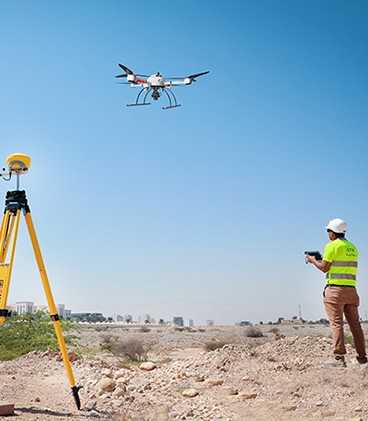
If you’re searching for drone survey services in Oman, you’re likely to compare providers, prices, and capabilities – and wonder how to choose the right one.
Drone surveying (also known as UAV/Aerial surveying in Oman) has become an essential tool for industries like construction, oil & gas, mining, agriculture, real estate, infrastructure/road projects, coastal/marine, renewable energy (solar), and smart city/urban planning. It delivers the required project accuracy while enabling faster data collection, wider area coverage, improved site accessibility, and richer geospatial insights for efficient planning and decision-making.
The Reality: Not all drone survey companies in Oman deliver the same level of quality. This guide keeps things simple and practical – while helping you make an informed decision that aligns with your project goals.
Why Drone Survey Services in Oman Are in High Demand
Oman’s diverse terrain and rapidly developing infrastructure create a wide range of applications for UAV-based surveying and remote sensing.
Mountains, deserts, mining areas, industrial facilities, agricultural areas, road corridors, coastal zones, and large development sites can make conventional data-collection methods time-consuming and resource-intensive.
Depending on the project requirements, UAV technology can provide faster data acquisition, detailed spatial information, improved site visibility, and safer access to difficult or hazardous areas.
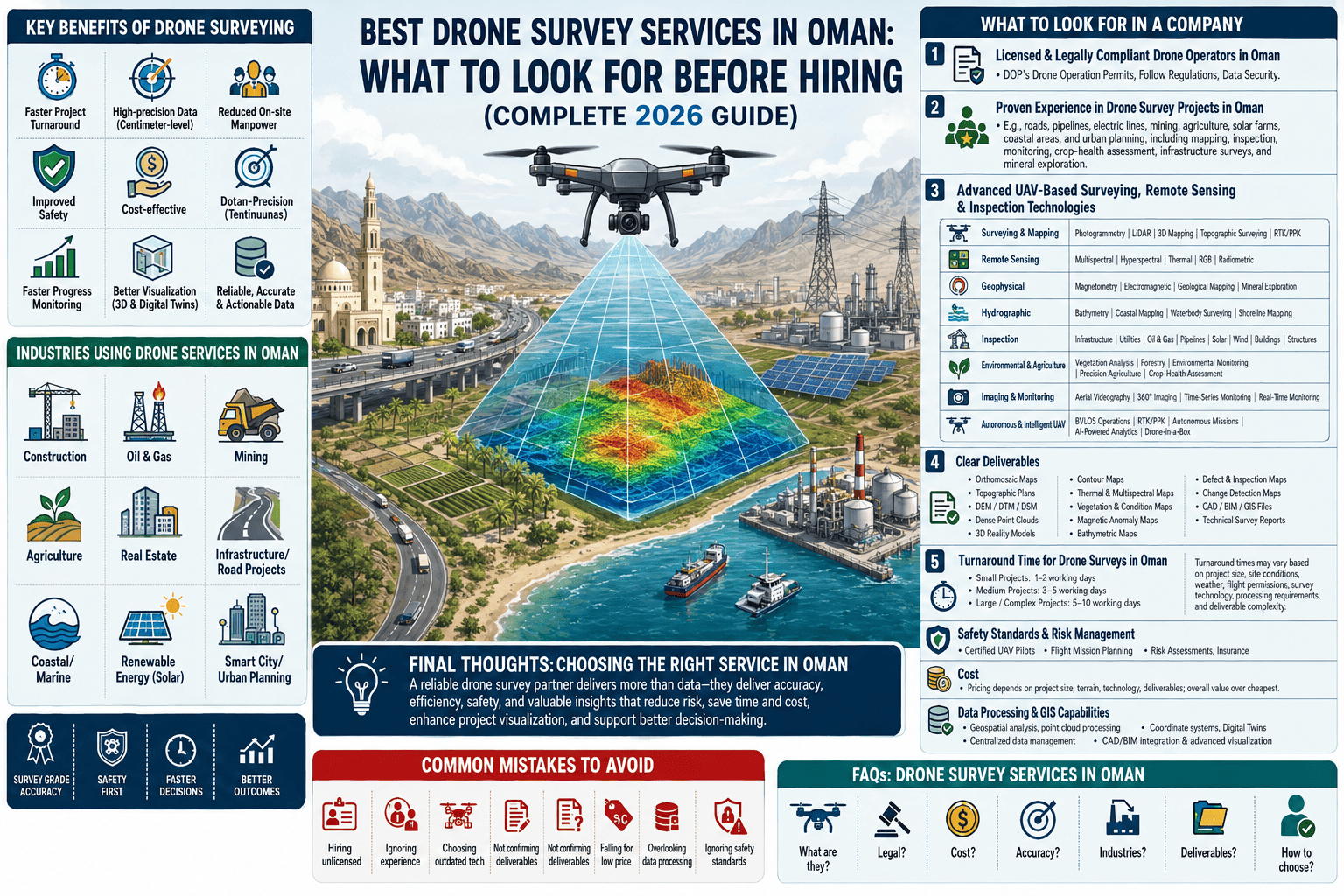
Key Benefits of Drone Surveying
- Faster project turnaround
- High-precision spatial data, when appropriate survey-grade equipment and workflows are used
- Reduced on-site manpower
- Improved safety in difficult, remote, or hazardous environments
- Cost-effective data acquisition for suitable project types and scales
- Faster progress monitoring and reporting
- Better visualization through 3D models and digital twins
- Repeatable data collection for monitoring and change detection
- Improved decision-making through geospatial analysis
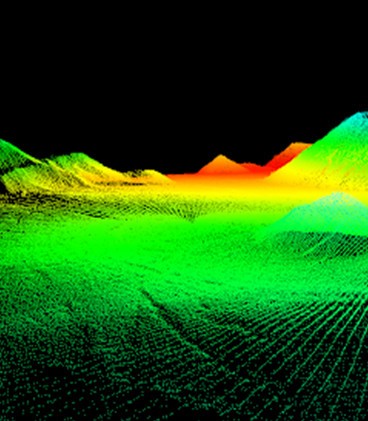
Applications can range from topographic surveying and photogrammetry to LiDAR, remote sensing, inspection, bathymetry, agricultural monitoring, geophysical surveys, and 3D modelling.
What to Look for in a Drone Survey Company in Oman
Choosing a UAV provider should not be based solely on whether the company owns a drone. A professional provider should have the regulatory compliance, technical expertise, survey methodology, processing capabilities, and project experience required to deliver reliable results.
1. Licensed & Legally Compliant Drone Operators in Oman
Before anything else, verify that the company is properly authorized to conduct the proposed UAV operations in Oman. A professional drone survey company should be able to demonstrate:
- Appropriate Drone Operation Permits (DOPs) and/or required operational approvals
- Qualified and authorized UAV pilots
- Compliance with applicable Omani aviation and drone regulations
- Appropriate flight planning and operational procedures
- Data security and responsible handling of collected information
- Appropriate insurance and operational coverage
Regulatory requirements may vary depending on the location, type of operation, aircraft, and project. Therefore, the provider should confirm that the specific proposed operation is properly authorized before flight activities begin.
2. Proven Experience with Drone Survey Projects in Oman
Local experience matters because UAV operations and survey requirements can vary significantly depending on terrain, site conditions, industry, and project objectives.
Look for a provider with demonstrated experience in areas such as:
- Roads and highways
- Pipelines
- Electrical transmission and utility corridors
- Mining and quarrying
- Agriculture Land Survey & Feasibility Assessment
- Solar farms and renewable energy
- Oil & gas facilities
- Construction and infrastructure
- Coastal and marine environments
- Real estate and land development
- Urban planning and smart-city projects
More importantly, look at what the company actually delivered, not simply whether it has operated a drone on the site. Relevant project experience may include:
- Topographic mapping
- Infrastructure surveying
- Corridor mapping
- Pipeline monitoring
- Asset inspection
- Construction progress monitoring
- Crop-health assessment
- Agricultural Land & Vegetation Analysis
- Stockpile and volume calculations
- Mineral Prospectivity Mapping
- Coastal and shoreline mapping
- Solar-panel inspection
- 3D modelling and visualization
Ask for relevant project examples and understand the scope, technology, accuracy requirements, processing workflow, and final deliverables.
3. Advanced UAV Surveying, Remote Sensing & Inspection Technologies
A professional provider should have access to the right UAV platforms, sensors, positioning systems, and data-processing technologies for the specific project.
Surveying & Mapping:
- Photogrammetry
- LiDAR
- 3D Mapping
- Topographic Surveying
- RTK/PPK
Remote Sensing:
- Multispectral
- Hyperspectral
- Thermal
- RGB
- Radiometric Imaging
Geophysical Surveying:
- Magnetometry
- Electromagnetic Surveys
- Geological Mapping
- Mineral Exploration
Hydrographic & Coastal Surveying:
- Bathymetry
- Coastal Mapping
- Waterbody Surveying
- Shoreline Mapping
Infrastructure & Industrial Inspection:
- Infrastructure
- Utilities
- Oil & Gas
- Pipelines
- Solar
- Wind
- Buildings
- Structures
Environmental & Agricultural Applications:
- Vegetation Analysis
- Forestry
- Environmental Monitoring
- Precision Agriculture
- Crop-Health Assessment
Imaging & Monitoring:
- Aerial Videography
- 360° Imaging
- Time-Series Monitoring
- Real-Time Monitoring
- Progress Monitoring
Autonomous & Intelligent UAV Systems:
- BVLOS Operations
- RTK/PPK
- Autonomous Missions
- AI-Powered Analytics
- Drone-in-a-Box
4. Clear & Well-Defined Deliverables
One of the most important questions to ask before hiring a drone survey provider is: “Exactly what will we receive at the end of the project?”
Depending on the scope, professional UAV survey deliverables may include:
- High-Resolution Orthomosaic Maps
- Topographic Plans
- Contour Maps
- Spot Levels
- DEM / DTM / DSM
- Dense Point Clouds
- 3D Reality Models
- CAD Files
- GIS-Compatible Data
- BIM-Ready Models
- Scan-to-BIM Deliverables
- As-Built Plans
- Engineering Drawings
- Cross-Sections
- Longitudinal Profiles
- Cut-and-Fill Analysis
- Stockpile Volume Calculations
- Thermal Maps & Inspection Reports
- Multispectral Vegetation Maps
- Vegetation & Condition Maps
- Magnetic Anomaly Maps
- Bathymetric Maps
- Defect & Inspection Maps
- Change Detection Maps
- Construction Progress Reports
- Technical Survey Reports
For survey projects, it is also important to define relevant coordinate systems, georeferencing requirements, accuracy specifications, resolution, file formats, and quality-control requirements before the work begins.
5. Realistic Turnaround Time for Drone Surveys in Oman
One of the major advantages of UAV surveying is rapid data acquisition. However, flight time and final deliverable turnaround time are not the same thing.
A project may require field data collection followed by photogrammetric processing, point-cloud processing, classification, modelling, quality control, analysis, and report preparation. Typical indicative timelines may be:
- Small Projects: 1–2 working days
- Medium Projects: 3–5 working days
- Large / Complex Projects: 5–10 working days
Actual turnaround depends on:
- Project Size
- Site Conditions
- Terrain & Accessibility
- Weather Conditions
- Flight Permissions & Restrictions
- UAV & Sensor Technology
- Ground-Control Requirements
- Data Volume
- Processing Requirements
- Accuracy Requirements
- Deliverable Complexity
- Operational Requirements
A professional provider should give you a realistic timeline covering both field acquisition and final data delivery.
6. Safety Standards & Risk Management
Professional UAV surveying requires more than simply flying an aircraft over a project site. The provider should have appropriate procedures covering:
- Certified Drone Pilots
- Flight Mission Planning
- Site & Risk Assessment
- Airspace & Operational Checks
- Pre-Flight & Equipment Inspections
- Emergency & Contingency Procedures
- Weather & Environmental Considerations
- Insurance Coverage
This becomes particularly important when operating around roads, populated areas, industrial facilities, power infrastructure, oil & gas facilities, construction sites, and other sensitive environments.
7. Cost of Drone Survey Services in Oman
When comparing drone survey costs in Oman, the lowest quotation is not necessarily the best value. Pricing can depend on:
- Project Area & Size
- Terrain Complexity
- Site Accessibility
- Required Accuracy
- UAV Platform
- Sensor Technology
- RTK/PPK Requirements
- Ground-Control Requirements
- Survey Locations
- Data Processing Requirements
- Required Deliverables
- Reporting Requirements
- Inspection & Monitoring Scope
- Operational Requirements
For example, a basic RGB photogrammetry project and a LiDAR, thermal, multispectral, magnetic, or bathymetric survey should not be compared simply on the basis of a price per flight. Compare the total project value—including accuracy, technology, experience, processing, quality control, deliverables, and support—not just the lowest price.
8. Data Processing, GIS & Geospatial Capabilities
Capturing aerial imagery is only one part of a professional drone survey. The real value comes from converting UAV data into accurate, usable, and actionable geospatial information. Look for capabilities such as:
- Geospatial Analysis
- Photogrammetric Processing
- LiDAR Point-Cloud Processing & Classification
- Coordinate-System Management
- Georeferencing
- Spatial Data Processing
- Feature Extraction
- Terrain & Surface Modelling
- CAD Integration
- BIM Integration
- GIS Integration
- 3D Visualization
- Digital Twin Development
- Change Detection
- Volume & Area Calculations
- Geospatial Data Management
- Cloud-Based Project Sharing
- Collaborative Data Management
A strong provider should be able to explain how the captured UAV data will be processed, validated, and converted into the final engineering, GIS, inspection, or decision-support outputs required by the client.
Industries Using Drone Survey Services in Oman
- Construction: Site mapping, topographic surveys, earthwork calculations, progress monitoring, and 3D modelling.
- Oil & Gas: Pipeline corridors, facility inspection, thermal assessment, monitoring, and asset documentation.
- Mining & Quarrying: Stockpile volume calculations, terrain mapping, mine-site monitoring, geological applications, and mineral exploration.
- Agriculture: Crop-health assessment, multispectral analysis, vegetation monitoring, irrigation assessment, and precision agriculture.
- Real Estate & Land Development: Land mapping, site assessment, development planning, topographic surveys, and 3D visualization.
- Infrastructure & Road Projects: Road corridors, topographic mapping, construction monitoring, asset inspection, and progress documentation.
- Coastal & Marine: Shoreline mapping, coastal monitoring, bathymetric surveys, and waterbody surveying.
- Renewable Energy: Solar-panel inspection, thermal analysis, site assessment, and renewable-energy asset monitoring.
- Smart Cities & Urban Planning: GIS mapping, 3D city modelling, development monitoring, infrastructure mapping, and digital-twin applications.
Common Mistakes to Avoid When Hiring Drone Survey Services
When selecting a UAV survey provider, avoid:
- Hiring drone operators without fundamental surveying knowledge
- Ignoring the surveyor’s professional background and fundamental surveying knowledge
- Treating UAV surveying as a standalone technology rather than integrating it with conventional surveying practices
- Failing to establish an accurate ground-control network
- Selecting UAV platforms or sensors unsuitable for the project
- Choosing providers based only on technology or marketing claims
- Not verifying the surveyor’s qualifications and relevant experience
- Overlooking proper georeferencing, field verification, and quality control
- Ignoring data-processing and GIS/CAD/BIM capabilities
- Comparing providers based only on price
- Failing to define deliverables, validation procedures, and turnaround times
A drone is a data-acquisition tool—not a replacement for a professional surveyor. Accurate UAV surveying depends on sound surveying principles, a properly established ground-control network, and the correct use of conventional survey equipment to control and validate the final results.
Final Thoughts: Choosing the Right Drone Survey Service in Oman
Choosing the right drone survey company in Oman is not simply about finding a company that operates UAVs.
The right provider should bring together:
- Regulatory compliance
- UAV expertise
- Surveying capability
- Appropriate sensors
- Professional data processing
- Safety management
- Clear deliverables
A reliable drone survey partner can help you:
- Save time and project costs
- Improve spatial data quality
- Reduce exposure to hazardous environments
- Improve project monitoring
- Enhance visualization
- Support engineering and planning decisions
- Generate accurate and actionable geospatial information
Before selecting a provider, compare their licenses and approvals, relevant Oman project experience, technology, survey methodology, accuracy, deliverables, processing capabilities, safety procedures, turnaround time, and overall project value. Choose a technical partner—not simply a drone operator.
FAQs: Drone Survey Services in Oman
Drone survey services use UAV platforms and specialized sensors to collect aerial, spatial, inspection, mapping, remote-sensing, and geospatial data for applications such as construction, infrastructure, oil & gas, mining, agriculture, utilities, renewable energy, and coastal projects.
UAV operations in Oman are subject to applicable aviation and drone regulations, permits, approvals, and operational requirements. Clients should ensure that their selected provider has the appropriate authorization for the specific operation for project requirements.
There is no single standard price. Cost depends on the project area, terrain, required accuracy, UAV and sensor technology, operational requirements, processing, reporting, and final deliverables.
Accuracy depends on the sensor, UAV platform, RTK/PPK positioning, ground-control strategy, flight planning, terrain, processing methodology, and required specifications. Survey-grade UAV projects can achieve high levels of positional accuracy when appropriate equipment, control, methodology, and quality assurance are used. Therefore, accuracy should always be specified and verified for the individual project rather than assumed simply because a drone is being used.
Applications include: Construction, Oil & Gas, Mining, Agriculture, Real Estate, Infrastructure/Road Projects, Renewable Energy (Solar), Coastal & Marine, Smart City/Urban Planning, and Environmental Monitoring.
Depending on the project, deliverables can include: Ortho mosaic maps, topographic plans, DEM/DTM/DSM, point clouds, 3D reality models, contour maps, CAD/GIS files, BIM-ready models, thermal maps, multispectral maps, bathymetric maps, magnetic anomaly maps, change-detection outputs, inspection reports, and technical survey reports.
Look beyond price. Choose a provider based on:
- Regulatory Compliance
- Proven Oman Project Experience
- Advanced UAV & Sensor Technology
- Qualified Surveyors & Remote-Sensing Expertise
- CP & GCP Networks for High-Accuracy Surveying
- Rigorous Accuracy & Quality Control
- Clear, Survey-Ready Deliverables
- GIS, CAD & BIM Capabilities
- Safety & Risk Management
- Reliable Turnaround Time
- End-to-End Survey Solutions
- Overall Project Value