Construction projects today demand speed, accuracy, and strict quality control. Whether it’s a highway, airport, industrial facility, oil & gas project, commercial building, or residential development, timely material testing plays a critical role in ensuring structural integrity and regulatory compliance.
Traditionally, samples were collected from project sites and transported to a central laboratory for testing. While effective, this process often resulted in delays, transportation risks, and slower decision-making.
Today, onsite laboratory services in Oman have transformed the way construction and engineering projects are managed. Mobile laboratories equipped with advanced testing equipment bring the laboratory directly to the project location, enabling faster testing, immediate reporting, and improved quality assurance.
This guide explains everything you need to know about onsite laboratory services in Oman, their benefits, applications, and how to choose the right laboratory partner.
What Are Onsite Laboratory Services?
An onsite laboratory is a fully equipped mobile or temporary testing facility established directly at a construction or industrial project site.
Instead of transporting materials to an external laboratory, qualified technicians perform testing at the project location using calibrated equipment and recognised test methods such as ASTM and BS EN standards.
Typical onsite laboratories can perform:
- Soil testing
- Aggregate testing
- Concrete testing
- Asphalt testing
- Water testing
- Compaction testing
- Density testing
- Moisture analysis
- Field quality control
- Sample preparation
This significantly reduces waiting time while ensuring continuous monitoring throughout the project lifecycle.
Why Are Onsite Laboratories Becoming Popular in Oman?
Oman is witnessing rapid growth in:
- Infrastructure development
- Smart city projects
- Industrial zones
- Ports
- Airports
- Oil & gas facilities
- Renewable energy projects
- Mining operations
- Commercial developments
Large-scale projects require continuous material testing every day. Sending hundreds of samples to distant laboratories creates delays that can impact construction schedules.
An onsite laboratory eliminates these challenges by providing:
- Faster testing
- Immediate quality verification
- Reduced transportation costs
- Faster project approvals
- Better coordination with engineers
- Continuous monitoring
This helps contractors maintain construction schedules without compromising quality.
Industries That Require Onsite Laboratory Services
Onsite laboratories are commonly used across multiple industries in Oman.
Construction Projects
Construction companies require regular testing of:
- Concrete
- Cement
- Steel reinforcement (sampled on site, tensile-tested at the main laboratory)
- Aggregates
- Soil
- Water
Field laboratories ensure every batch meets project specifications before use.
Road and Highway Projects
Road construction requires continuous testing of:
- Asphalt
- Base course
- Subgrade
- Compaction
- Aggregate quality
- Bitumen
An onsite laboratory enables immediate adjustments during paving operations.
Oil & Gas Projects
Oil & gas facilities demand rigorous quality control for:
- Soil stability
- Foundation materials
- Concrete strength
- Structural materials
Mobile laboratories help maintain compliance with project specifications while reducing delays.
Infrastructure Projects
Major infrastructure projects such as:
- Bridges
- Railways
- Airports
- Water treatment plants
- Utility corridors
require daily material verification. Onsite laboratories improve coordination between consultants, contractors, and project owners.
Mining Projects
Mining developments require:
- Soil investigation
- Aggregate testing
- Rock testing
- Environmental sampling
Mobile laboratories support continuous testing in remote project locations.
Common Tests Performed in Onsite Laboratories
A professional onsite laboratory typically performs a wide range of field and laboratory tests. These include:
Soil Testing
- Moisture Content
- Atterberg Limits
- Grain Size Analysis
- Proctor Compaction
- California Bearing Ratio (CBR)
- Field Density Test
Concrete Testing
- Slump Test
- Cube Sampling and Curing
- Compressive Strength
- Temperature Monitoring
- Air Content
- Density
Aggregate Testing
- Sieve Analysis
- Flakiness Index
- Elongation Index
- Crushing Value
- Impact Value
- Water Absorption
Asphalt Testing
- Marshall Stability
- Bitumen Content
- Bulk and Maximum Density
- Degree of Compaction (Core Density)
- Temperature Monitoring
Water Testing
- pH
- Chloride
- Sulphate
- Total Dissolved Solids (TDS)
- Suitability of Water for Concrete Mixing
Benefits of Using Onsite Laboratory Services
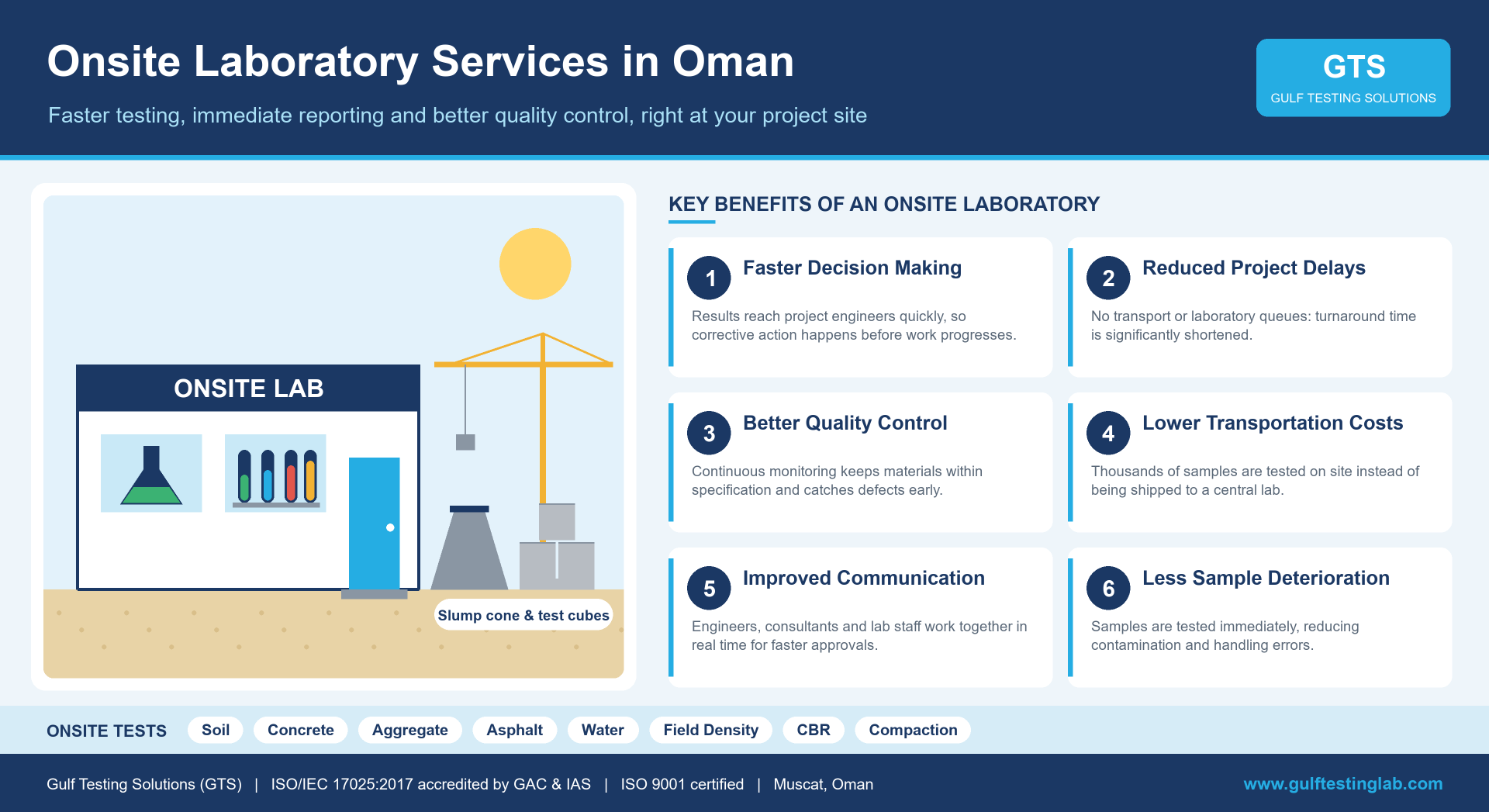
1. Faster Decision Making
Project engineers receive results much faster than sending samples to offsite laboratories. Immediate feedback allows corrective action before construction progresses further.
2. Reduced Project Delays
Transportation and laboratory queues can delay testing. An onsite laboratory significantly shortens turnaround time.
3. Better Quality Control
Continuous monitoring ensures:
- Materials comply with specifications
- Construction quality remains consistent
- Defects are detected early
4. Lower Transportation Costs
Large infrastructure projects generate thousands of material samples. Testing onsite eliminates repeated transportation expenses.
5. Improved Communication
Project managers, consultants, and laboratory engineers work together in real time. This improves coordination and speeds up approvals.
6. Less Sample Deterioration
Samples are tested immediately after collection, reducing the risk of contamination, deterioration, or handling errors.
What Equipment Does an Onsite Laboratory Use?
Modern mobile laboratories include advanced equipment such as:
- Compression Testing Machines
- Curing Tanks
- Sieve Shakers
- Soil Compaction Equipment
- Moisture Meters
- Digital Balances
- Ovens
- Aggregate Testing Machines
- CBR Equipment
- Concrete Slump Cones
- Field Density Equipment
- Asphalt Testing Instruments
- Sample Preparation Equipment
All equipment should be regularly calibrated according to international standards.
How to Choose the Right Onsite Laboratory Service Provider in Oman
Not every laboratory offers the same level of expertise. When selecting a laboratory, consider the following factors.
ISO/IEC 17025 Accreditation
Choose a laboratory that is accredited to ISO/IEC 17025:2017 by a recognised accreditation body, and confirm that the tests you need are within its accredited scope. Accreditation demonstrates technical competence and reliable testing practices.
Experienced Engineers
Qualified civil engineers, laboratory technicians, and geotechnical specialists ensure accurate testing and reporting.
Modern Equipment
Advanced, calibrated instruments produce more reliable and repeatable test results.
Fast Reporting
Timely reports help project teams make informed decisions without delaying construction.
Wide Testing Capability
The ideal laboratory should provide comprehensive testing services, including:
- Geotechnical testing
- Material testing
- Concrete testing
- Asphalt testing
- Aggregate testing
- Chemical testing
- Microbiological testing (where applicable)
Nationwide Coverage
Projects often take place in remote areas across Oman. Choose a laboratory capable of mobilizing equipment and personnel anywhere in the country.
Gulf Testing Solutions (GTS): Onsite Laboratory Services Across Oman
Gulf Testing Solutions (GTS), headquartered in Muscat, delivers professional field laboratory solutions for construction, infrastructure, industrial, oil & gas, and engineering projects.
GTS is accredited to ISO/IEC 17025:2017 by GAC and IAS and certified to ISO 9001. It runs dedicated divisions for Civil and Geotechnical, Asphalt and Pavement, NDT, Mining Geochemistry, and Food and Agro testing.
The company provides fully equipped onsite laboratories supported by experienced engineers and qualified technicians. Their services include:
- Construction Material Testing
- Geotechnical Investigation
- Soil Testing
- Concrete Testing
- Aggregate Testing
- Asphalt Testing
- Chemical Testing
- Microbiological Testing
- Quality Assurance
- Quality Control
- Field Density Testing
- Project Site Laboratory Setup
With advanced testing equipment, experienced professionals, and strict adherence to international testing standards, GTS supports projects across Oman with accurate, timely, and dependable testing services.
Conclusion
Whether it is a highway, airport, industrial plant, residential complex, or energy project, onsite laboratory services have become an essential part of modern construction management in Oman.
Talk to GTS About Your Project
Planning a project that needs a site laboratory? Contact Gulf Testing Solutions (GTS) through www.gulftestinglab.com to discuss your testing requirements, mobilisation timeline and reporting needs.
Frequently Asked Questions
What is an onsite laboratory?
An onsite laboratory is a testing facility set up at the project site and staffed by qualified technicians. It performs routine quality control tests on soil, concrete, aggregates and asphalt as construction progresses.
Are onsite laboratory results accredited?
Only if the site laboratory and the specific tests are included in the provider’s ISO/IEC 17025 accredited scope. Always ask for the scope of accreditation before appointing a laboratory.
Which tests still need the main laboratory?
Specialised tests such as reinforcement steel tensile testing, detailed chemical analysis and microbiological testing are normally performed at the main laboratory, using samples collected on site.