If you’re looking into food pesticide testing services in Oman, chances are you’re thinking about product safety, regulatory compliance, and consumer protection — and rightly so.
Testing for pesticide residues is becoming an increasingly critical part of food safety across today’s food industry supply chain. As Oman’s food safety control systems continue to strengthen, laboratory testing for pesticide residues is now essential for both imported and locally produced foods.
At Gulf Testing Solutions Enterprises LLC (GTS), we work with importers, distributors, processors, and retailers across Oman to help them answer one essential question with confidence: is this food product safe? In this guide, we explain why food pesticide testing matters, who should be conducting it, and what to look for in a reliable testing partner.
What Is Food Pesticide Testing?
Food pesticide testing is the process of analyzing food products to detect and measure pesticide residues.
These residues may result from the use of pesticides during cultivation, storage, or handling of crops. Food products placed on the market must meet defined limits for pesticide residues, which is why this type of testing is a core part of any food safety management system.
In short, pesticide residue testing lets businesses answer one crucial question with evidence, not assumption: is this food product safe?
Why Food Pesticide Testing Matters in Oman
Food safety isn’t just about appearance, freshness, or shelf life — it also depends on whether products meet accepted safety standards for chemical residues.
Oman’s food control framework has strengthened laboratory-based testing, including pesticide residue analysis, with food control laboratories expected to meet international accreditation standards such as ISO/IEC 17025.
For businesses involved in importing, processing, distributing, or selling food products, pesticide testing matters for several reasons:
- It helps identify non-compliant products before they enter the market
- It supports safer sourcing and supplier verification
- It reduces the risk of rejected shipments, complaints, or reputational damage
- It strengthens confidence during inspections, audits, and client approvals
Pesticides are intrinsically toxic with potential health implications, which is why regular monitoring of residues in food and the environment is required — with unsafe exposure controlled through proper regulation, monitoring, and food safety limits.
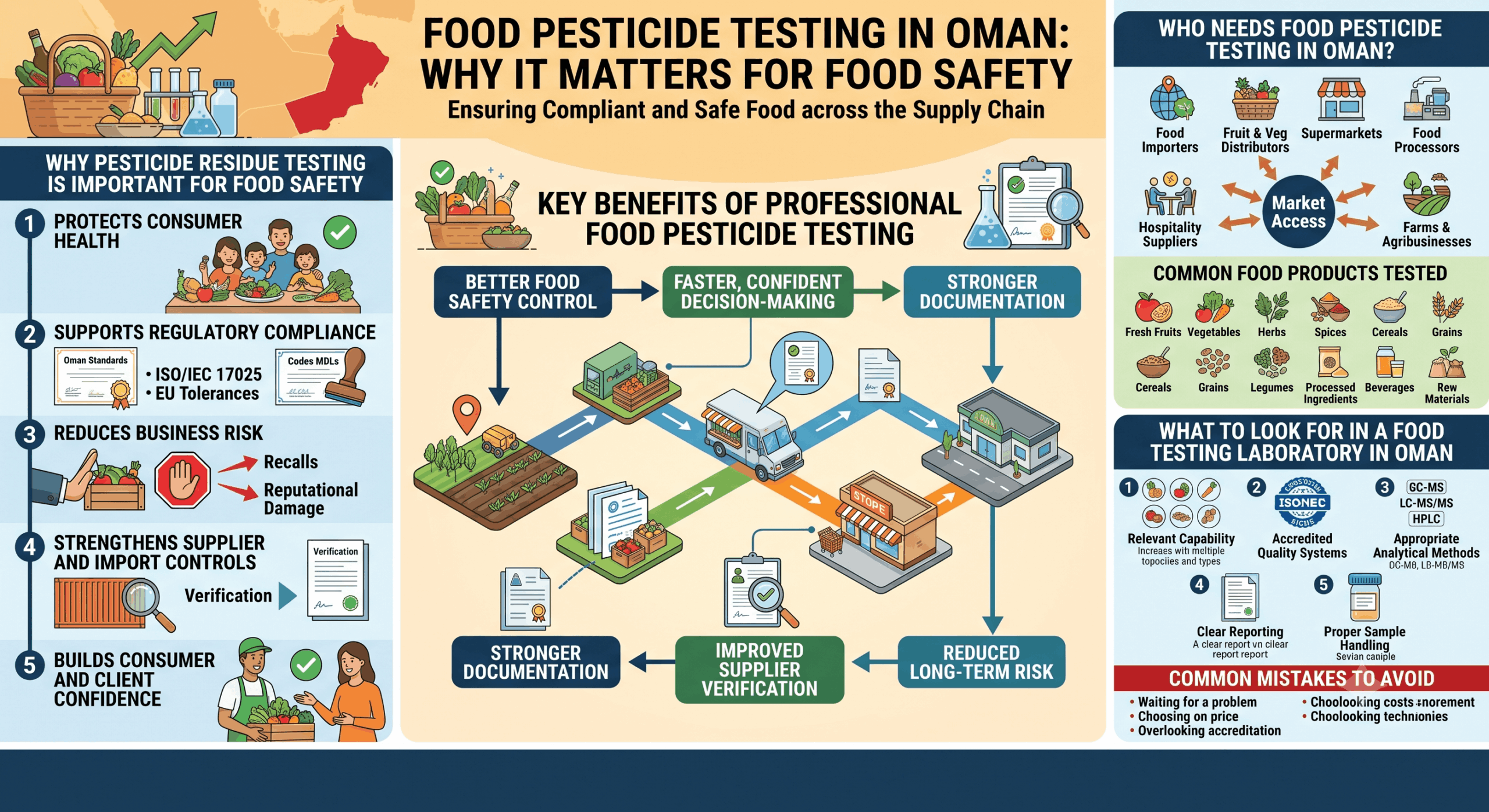
Why Pesticide Residue Testing Is Important for Food Safety
1. It Protects Consumer Health
The most important reason for pesticide testing is to ensure food safety. Pesticides are widely used in agriculture and leave behind residues — what matters is that these residues remain within accepted limits. Governments and international bodies use scientific risk assessments to establish safe intake levels and maximum residue limits, helping reduce the risk of harmful exposure over time.
2. It Supports Regulatory Compliance
For food businesses, compliance is a top priority. Imported fresh fruit and vegetables may require pesticide residue analysis certificates showing compliance with Codex MRLs or EU tolerances. Reliable residue testing supports smoother documentation, stronger due diligence, and better preparedness for market requirements.
3. It Helps Reduce Business Risk
Pesticide testing isn’t only about safety — it’s also about risk management. Testing helps reduce the risk of:
- Shipment rejection
- Supply chain disputes
- Product withdrawal
- Brand damage
- Non-compliance during inspections
- Avoidable delays in product release
Failure to comply with permitted residue levels can lead to recalls, reputational damage, and loss of market access.
4. It Strengthens Supplier and Import Controls
If you source products from multiple farms, traders, or countries, pesticide residue testing gives you an extra layer of quality assurance. Instead of relying only on supplier declarations, businesses can use testing to verify whether products meet required standards before distribution, processing, or retail sale.
5. It Builds Consumer and Client Confidence
Food safety expectations are rising across supply chains. Whether your customer is a retailer, hotel group, food processor, distributor, or institutional buyer, documented testing shows that your business takes food safety seriously — particularly important for higher-risk fresh produce categories or imported consignments.
Who Needs Food Pesticide Testing in Oman?
Food pesticide testing is valuable for a wide range of businesses and organizations, including:
- Food importers
- Fruit and vegetable distributors
- Supermarkets and retail chains
- Food processors and packers
- Hospitality and catering suppliers
- Farms and agribusinesses
- Quality assurance and compliance teams
- Government-linked procurement and institutional supply chains
In practice, any business handling food products with potential residue exposure can benefit from a structured testing approach.
Common Food Products Tested for Pesticide Residues
Pesticide residue testing is commonly used for products such as:
- Fresh fruits
- Vegetables
- Herbs and spices
- Cereals and grains
- Legumes and pulses
- Beverages
- Processed food ingredients
At GTS, our Food & Pesticides Analysis service covers food and drink categories including cereals, grains, legumes, dairy, fish, fruit, meat, spices, and vegetables, with tailored testing packages available for processed foods, fresh produce, beverages, and raw materials.
Key Benefits of Professional Food Pesticide Testing
- Better Food Safety Control: Testing gives businesses clearer visibility into chemical residue risks before products move further along the supply chain.
- Faster and More Confident Decision-Making: When results are clear and properly reported, teams can make better decisions on acceptance, release, investigation, or supplier follow-up.
- Stronger Documentation: Laboratory reports support internal quality systems, audits, supplier evaluations, and compliance records.
- Improved Supplier Verification: Testing helps confirm whether supplier controls are working in practice — not just on paper.
- Reduced Long-Term Risk: Early detection of residue issues helps avoid larger commercial, regulatory, or reputational problems later. At GTS, we go beyond single-point pesticide screening — our Food & Pesticides Analysis service combines residue testing with food safety testing, chemical analysis, contaminant detection, and nutritional analysis, giving businesses a broader food quality and compliance support structure.
What to Look for in a Food Testing Laboratory in Oman
- Relevant Pesticide Residue Testing Capability: Make sure the laboratory can test the food categories relevant to your business. At GTS, we offer multi-class pesticide screening and customized testing packages for fresh produce, beverages, processed foods, and raw materials — rather than limited, single-point screening.
- Accredited Quality Systems: Accreditation matters because food safety decisions depend on reliable results. Oman’s food safety system places importance on internationally accredited laboratories, particularly ISO/IEC 17025 for testing competence. GTS laboratories are accredited to ISO/IEC 17025 and certified under ISO 9001, reflecting the quality framework businesses should expect from a testing partner.
- Appropriate Analytical Methods: The laboratory should use suitable analytical techniques for sensitive and reliable detection. At GTS, we use methods such as GC-MS, LC-MS/MS, and HPLC to detect organophosphates, carbamates, pyrethroids, and other pesticide classes. Whichever provider you choose, this is the type of technical capability worth confirming upfront.
- Clear Reporting and Practical Interpretation: A good laboratory should provide reports that are easy to understand, well-structured, and useful for decision-making.
- Proper Sample Handling Procedures: Chain of custody, sample integrity, and consistent handling are essential to credible testing.
- Turnaround Time: For many businesses, speed matters — especially for perishable products, shipment clearance, or release decisions.
- Communication and Technical Support: A reliable lab should be able to explain the scope of testing, reporting format, and how the service fits your product type and business needs.
Common Mistakes to Avoid
When arranging food pesticide testing in Oman, avoid these common mistakes:
- Waiting until a problem appears before testing
- Choosing a laboratory based only on price
- Not confirming whether the lab handles your product category
- Overlooking accreditation and quality procedures
- Failing to define a clear sampling plan
- Assuming all testing reports provide the same level of detail
- Relying only on supplier claims without verification
These issues can create unnecessary delays, uncertainty, and risk.
Choosing the Right Testing Partner: GTS
The right laboratory should do more than issue a test report. It should support your business with reliable methods, recognized quality systems, practical communication, and a testing scope that matches your products and compliance needs.
Gulf Testing Solutions Enterprises LLC (GTS) offers Food & Pesticides Analysis built around pesticide residue analysis, microbiological and chemical testing, and contaminant detection, aligned with international food safety frameworks such as Codex, WHO, FAO, EU, and FDA references. As an ISO/IEC 17025-accredited, multi-disciplinary testing and laboratory services company based in Muscat, Oman, we support food importers, distributors, processors, and retail businesses across the Sultanate.
Conclusion
Food pesticide testing in Oman is a practical and important part of modern food safety management.
For importers, processors, retailers, and supply chain stakeholders, testing helps improve compliance, reduce risk, strengthen supplier control, and protect consumer confidence. In a market where food safety expectations continue to rise, having reliable pesticide residue data is increasingly essential.
To strengthen food safety, reduce compliance risk, and improve confidence in your supply chain, work with a laboratory that offers both technical capability and practical reporting. At GTS, our Food & Pesticides Analysis service is built to do exactly that — get in touch to discuss your testing requirements.
FAQs: Food Pesticide Testing in Oman
1. What is food pesticide testing?
Food pesticide testing is the laboratory analysis of food products to detect and measure pesticide residues and assess whether they meet applicable safety limits.
2. Why is pesticide residue testing important?
It helps protect consumer health, supports regulatory compliance, and reduces business risk linked to unsafe or non-compliant food products.
3. Which food products are commonly tested?
Fresh fruits, vegetables, herbs, spices, cereals, grains, legumes, and other food products may be tested depending on the supply chain and risk profile. GTS also supports processed foods, beverages, and raw materials.
4. Who should use food pesticide testing services in Oman?
Importers, distributors, food processors, retailers, hospitality suppliers, and agribusinesses can all benefit from professional residue testing.
5. Why does laboratory accreditation matter?
Accreditation helps demonstrate that testing is carried out using recognized quality and competence standards, which improves confidence in the results.
6. Can pesticide testing help with imported food consignments?
Yes. Testing can support documentation, due diligence, and verification for imported food products, especially where residue compliance is important.