
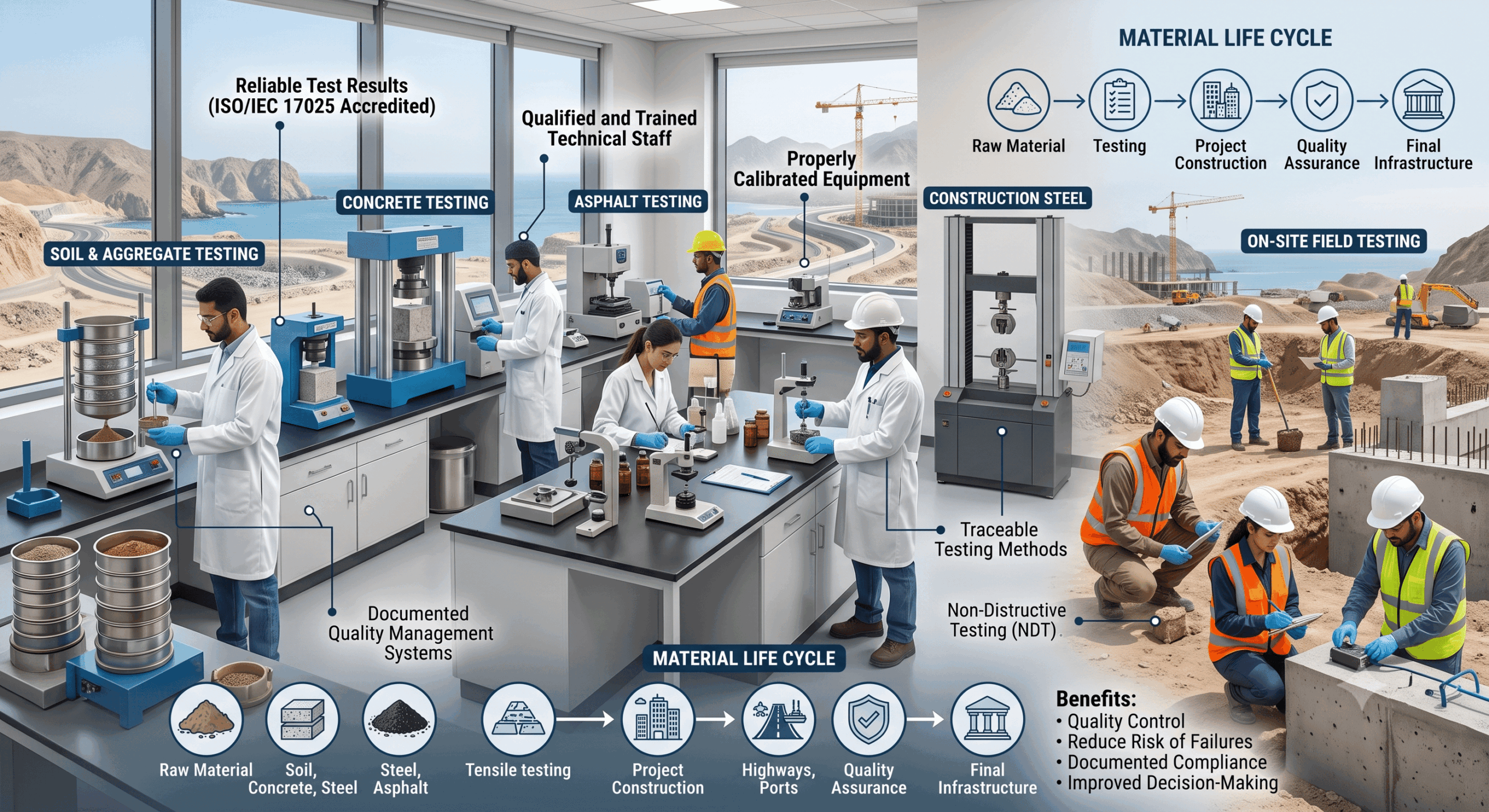
When you’re selecting a material testing laboratory in Oman, you need more than a stack of test reports. You need reliable results, accurate data, consistent procedures, and internationally recognized quality standards behind every number on the page.
Material testing plays a critical role in construction, infrastructure, industrial, and engineering projects across Oman. It confirms that materials meet required specifications, perform as expected, and comply with project requirements — which is exactly why consultants, contractors, developers, and project owners consistently choose to work with ISO-certified laboratories.
At Gulf Testing Solutions Enterprises LLC (GTS), this is the standard we operate by every day. In this guide, we explain why ISO certification matters, how it benefits your projects, and what to look for when choosing a testing partner in Oman.
What Is an ISO-Certified Material Testing Laboratory?
An ISO-certified material testing laboratory operates according to internationally recognized quality and competence standards.
For testing laboratories, the benchmark standard is ISO/IEC 17025. This accreditation demonstrates that a laboratory has the technical competence, equipment, procedures, and quality systems needed to produce accurate and reliable test results.
An ISO/IEC 17025-accredited laboratory typically maintains:
- Controlled testing procedures
- Qualified and trained technical staff
- Properly calibrated equipment
- Documented quality management systems
- Traceable testing methods
- Consistent reporting practices
For clients, this translates into greater confidence in the results used for design, quality control, approvals, and project decision-making.
Why Material Testing Matters in Oman
Material testing is far more than a routine technical requirement — it verifies that construction and industrial materials are suitable, safe, and compliant with project specifications.
Oman’s project landscape ranges from residential developments and highways to industrial plants, ports, and large-scale infrastructure. Material testing confirms that materials meet the required standards before and during construction, helping projects stay on schedule and within budget.
The benefits include:
- Verifying compliance with project specifications
- Supporting quality control during construction
- Reducing the risk of failures and costly rework
- Improving decision-making for consultants and contractors
- Providing documented evidence for approvals and compliance
Benefits of Choosing an ISO-Certified Material Testing Laboratory
- Reliable Test Results: ISO/IEC 17025 ensures that testing is performed using validated methods, qualified personnel, and controlled procedures. Reliable results let project teams make informed decisions with confidence.
- Stronger Quality Control: Material testing supports quality control at every stage of a project — from design and manufacturing through construction and operation — helping identify potential issues before they escalate into major problems.
- Better Compliance with Standards: An ISO-certified laboratory follows recognized testing methods and documented procedures, helping clients demonstrate compliance with project specifications and industry standards. This is especially important for materials such as concrete, aggregates, soil, asphalt, and construction steel.
- Improved Documentation and Traceability: Testing isn’t only about obtaining results — it’s about proving how those results were achieved. A quality-focused laboratory provides clear test reports, traceable records, proper sample identification, defined testing methods, and compliance observations where applicable. These records are invaluable during audits, inspections, disputes, and project handovers.
- Reduced Risk and Lower Costs: Material failures lead to delays, repairs, disputes, and unexpected expenses. Testing materials early and accurately helps identify problems before they affect larger areas of a project — reducing risk and minimizing costly rework.
- Greater Confidence for All Stakeholders: Material testing results influence decisions made by consultants, contractors, developers, and project owners. When testing is performed by a laboratory with recognized quality systems, every party can trust the data driving the project.
Who Can Benefit from Material Testing Services?
Material testing services are valuable for:
- Construction companies
- Infrastructure contractors
- Road and highway projects
- Consultants and supervision engineers
- Developers and project owners
- Industrial and oil & gas companies
- Precast and concrete product manufacturers
- Steel suppliers and fabricators
- Geotechnical and foundation contractors
Any project that depends on verified material quality can benefit from professional testing services.
Common Materials Tested in Oman
Material testing laboratories in Oman commonly test soil, aggregates, concrete, concrete products, construction steel, asphalt and pavement materials, and masonry-related materials.
At GTS, we provide testing services across soil, aggregates, concrete, concrete products, asphalt, and construction steel, using recognized standards such as ASTM, BS EN, AASHTO, ACI, and ISO, as applicable to each project.
Key Benefits of Choosing the Right Laboratory
- Better material acceptance decisions: Testing helps determine whether materials are suitable before they are used at scale.
- Faster problem identification: A competent laboratory helps identify quality issues earlier, reducing downstream impact on schedule and cost.
- Stronger technical confidence: Clear, consistent, and well-documented results make it easier for technical teams to justify decisions.
- Improved compliance support: Laboratory reports support project documentation, inspections, approvals, and quality records.
- Better long-term project performance: When materials are properly tested and verified, projects are far more likely to perform as intended over time.
What to Look for in a Material Testing Laboratory
When comparing laboratories, consider the following:
- ISO/IEC 17025 Accreditation: Demonstrates technical competence and helps ensure reliable results.
- Relevant Testing Scope: Choose a laboratory that can test the materials used in your project, whether soil, concrete, steel, aggregates, asphalt, or multiple material types.
- Recognized Testing Standards: The laboratory should use established standards such as ASTM, BS, AASHTO, ACI, or ISO methods.
- Qualified Staff and Modern Equipment: Reliable testing depends on both skilled personnel and properly maintained equipment.
- Clear Reporting: Reports should be accurate, easy to understand, and suitable for technical decision-making.
- Field and Laboratory Testing Capabilities: A laboratory offering both on-site testing and lab analysis provides greater convenience and efficiency.
- Local Experience in Oman: A laboratory with local experience better understands project requirements, regulations, and industry expectations.
Common Mistakes to Avoid
When selecting a material testing laboratory, avoid:
- Choosing based solely on price
- Failing to verify accreditation
- Assuming all laboratories offer the same services
- Not confirming which testing standards will be used
- Overlooking report quality
- Ignoring field testing requirements
- Waiting until problems occur before conducting testing
These mistakes can lead to project delays, quality issues, and increased costs.
Choosing the Right Testing Partner: GTS
The right laboratory should do more than provide test reports — it should support your project with reliable testing methods, recognized quality standards, clear communication, and services tailored to your technical requirements.
Gulf Testing Solutions Enterprises LLC (GTS) is an ISO/IEC 17025-accredited, multi-disciplinary testing, inspection, and laboratory services company based in Muscat, Oman. Our capabilities span civil and geotechnical testing, non-destructive testing (NDT), asphalt and pavement evaluation, mining geochemistry, food and agro testing, surveying, and inspection services.
Quality assurance is built into every stage of our process — from sample collection through to final reporting — supported by ISO/IEC 17025 accreditation, ISO 9001 certification, and a technical team experienced across Oman’s construction, infrastructure, and industrial sectors.
Final Thoughts
Choosing an ISO-certified material testing laboratory in Oman is about more than meeting a compliance checkbox. It’s about strengthening quality assurance, reducing project risk, and making informed decisions based on reliable data. A competent testing partner supports safer construction, better material performance, stronger documentation, and greater confidence throughout the project lifecycle.
When evaluating laboratories, look for a provider that combines recognized quality standards, technical expertise, and practical project support. At GTS, this is exactly what we deliver for consultants, contractors, and project owners across Oman.
Frequently Asked Questions
1. What is an ISO-certified material testing laboratory?
An ISO-certified laboratory operates according to internationally recognized quality and competence standards. For testing laboratories, ISO/IEC 17025 is the most relevant standard.
2. Why is ISO/IEC 17025 important?
It demonstrates that a laboratory has the competence, procedures, and systems required to produce reliable and accurate test results.
3. Which materials are commonly tested in Oman?
Commonly tested materials include soil, aggregates, concrete, concrete products, steel, asphalt, and other construction materials.
4. Who should use a material testing laboratory?
Contractors, consultants, developers, manufacturers, industrial companies, and project owners can all benefit from professional testing services.
5. What should I check before selecting a laboratory?
Review its accreditation status, testing capabilities, standards used, reporting quality, equipment, technical expertise, and experience with similar projects.
6. Does GTS provide material testing services in Oman?
Yes. GTS provides testing services for soil, aggregates, concrete, concrete products, asphalt, and construction steel, supported by ISO/IEC 17025 accreditation and ISO 9001 certification.