
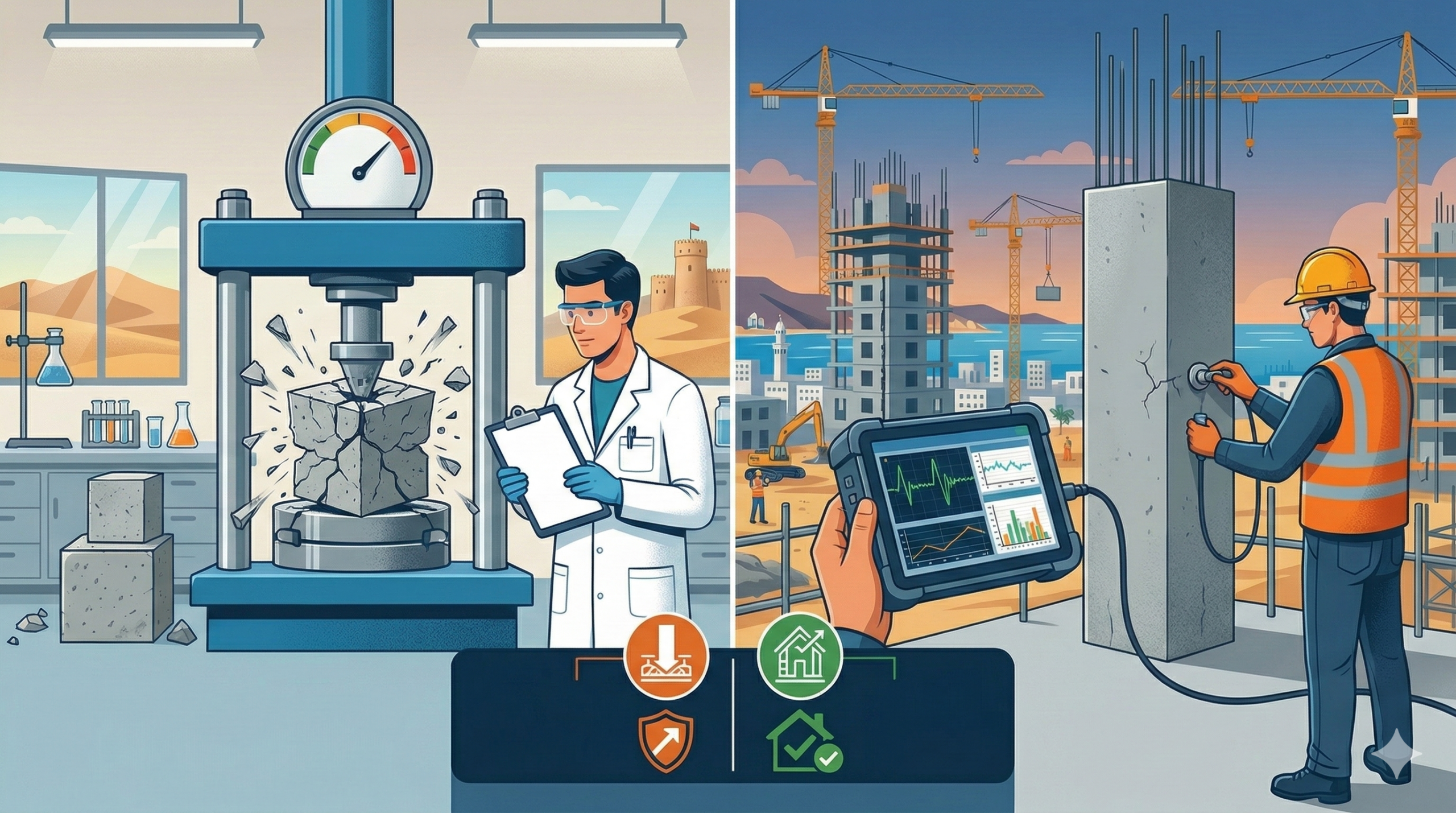
Difference Between Destructive and Non-Destructive Testing
What Every Construction Project in Oman Should Know
In Oman’s rapidly growing construction industry, quality isn’t just about meeting deadlines — it’s about building safely and building to last. Whether it’s a residential villa, a commercial tower, or a large infrastructure project in Muscat or anywhere across Oman, testing plays a critical role behind the scenes.
Two of the most important testing methods used in construction are Destructive Testing (DT) and Non-Destructive Testing (NDT). While they may sound technical, the difference between them is actually quite simple — and understanding it can help you make smarter decisions for your project.
Let’s break it down in a clear, practical way.
What Is Destructive Testing?
Destructive Testing is exactly what it sounds like — the material being tested is pushed to its limit until it fails.
Why would anyone want to break something on purpose?
Because it tells us exactly how strong it is.
For example, when concrete cubes are crushed in a lab, engineers can measure how much pressure the material can handle. When soil samples are tested under controlled pressure, specialists can determine how much weight the ground can safely support.
This type of testing is especially important during early project stages and is commonly performed by an accredited soil testing laboratory in Oman.
When Is Destructive Testing Used?
- Designing building foundations
- Determining soil bearing capacity
- Testing concrete strength
- Ensuring materials meet safety standards
Yes, the sample gets destroyed — but the insight gained helps prevent major structural failures later.
What Is Non-Destructive Testing?
Non-Destructive Testing, or NDT, checks the condition of materials and structures without damaging them.
Think of it as a health check-up for a building.
Using methods like ultrasonic testing or rebound hammer tests, engineers can inspect structures while keeping them fully intact. This makes NDT ideal for existing buildings, bridges, pipelines, and large facilities.
Many construction testing services in Oman rely on NDT for routine inspections and long-term structural monitoring.
When Is Non-Destructive Testing Used?
- Inspecting existing buildings
- Checking for cracks or hidden defects
- Quality control during construction
- Routine safety inspections
NDT helps detect problems early — before they become expensive repairs.
The Real Difference (In Simple Terms)
Here’s the easiest way to understand it:
- Destructive Testing tells you how strong something is by breaking it.
- Non-Destructive Testing tells you if something is healthy without breaking it.
Both methods serve different purposes — and most major projects in Oman use a combination of both.
Why This Matters for Construction in Oman
Soil conditions in Oman vary from coastal areas to desert terrain. That’s why professional geotechnical testing services in Oman are essential before any project begins.
A reliable soil testing lab in Muscat will typically perform:
- Borehole drilling
- Soil classification
- Compaction tests
- Bearing capacity analysis
- Laboratory material testing
Working with a trusted geotechnical investigation company in Oman ensures that your foundation design is based on real data — not assumptions.
And when construction begins, ongoing construction testing services in Oman help maintain quality every step of the way.
Why Accreditation Matters
Choosing an accredited soil testing laboratory in Oman means:
- Results you can trust
- Compliance with international standards
- Approval from regulatory authorities
- Reduced project risks
- Better long-term performance
In construction, cutting corners on testing can lead to serious consequences. Reliable testing protects your investment — and your reputation.
Which Testing Method Do You Need?
It depends on your project stage:
✔ Planning a new building? You’ll need destructive soil and material testing.
✔ Inspecting an existing structure? Non-destructive testing is the smarter choice.
✔ Large commercial project? You’ll likely need both.
For most developments across Muscat and the wider GCC region, combining both approaches provides the most complete quality assurance.
Final Thoughts
Destructive and Non-Destructive Testing aren’t competing methods — they work together to ensure safety, durability, and compliance.
If you’re searching for:
- Geotechnical testing services in Oman
- Soil testing lab in Muscat
- Geotechnical investigation company Oman
- Construction testing services Oman
- Accredited soil testing laboratory Oman
Choosing an experienced, locally trusted laboratory can make all the difference between a project that simply stands — and one that stands strong for decades.